
Leafy vegetables
Lettuce, spinach and cabbage for fresh-cut preparation, salad production or packing.

Share the latest company updates, product launches, and inspiring stories from behind the scenes.

Share the latest company updates, product launches, and inspiring stories from behind the scenes.
Release time:
2025-10-21
Ultrasonic ozone washing machines represent a cutting-edge advancement in the realm of industrial cleaning equipment. Combining two powerful cleaning technologies—ultrasonic waves and ozone—these machines offer a method that is not only efficient but also environmentally friendly. Understanding how they work and their benefits can help businesses leverage this technology to improve their cleaning
Fengxiang offers multiple machine configurations that can combine bubble washing, ozone treatment and optional ultrasonic cleaning, with equipment selected to match your required capacity and process.

A washing line is selected by matching the cleaning process to the crop, target output and next production step. The modules below describe their roles; actual results depend on the product, operating conditions and validated process settings.
| Process element | Role in the line | Configuration note |
|---|---|---|
| Bubble washing | Agitates produce in water to help release soil and loose surface impurities. | Set agitation and conveying to suit produce delicacy and soil load. |
| Ozone treatment | Adds an ozone treatment stage to the wash process. | Confirm treatment design, control and operating parameters for the application. |
| Ultrasonic cleaning | Optional module intended to support removal of adhered particles. | Availability and suitability should be confirmed for the selected model and crop. |
| Water circulation/filtration | Supports water management during continuous production. | Review water quality, replacement and sanitation procedures with the supplier. |
This page is a solution overview, not a guarantee of microbial reduction, cleaning outcomes or regulatory compliance. Validate process performance with representative produce and your food-safety plan.
The washing stage can be evaluated for different produce categories. Confirm the suitable handling method with sample trials, especially for delicate or cut products.
Lettuce, spinach and cabbage for fresh-cut preparation, salad production or packing.
Carrots and potatoes where soil load, surface condition and conveying need review.
Wash-stage planning before dewatering, portioning and packaging.
Vegetables such as beans, broccoli and peas before blanching or freezing.
Fruit washing configurations assessed according to variety and handling needs.
Commercial preparation environments with repeatable workflows and line constraints.
Ultrasonic cavitation supports physical soil removal while ozone provides an oxidation treatment step. Bubble agitation, filtration and rinsing may be combined around them. The exact sequence and whether both technologies are installed together depend on the crop, required output and validated process.
Water movement helps loosen soil and surface debris. The feed, agitation and discharge method should reflect the crop's shape and fragility.
When a suitable ultrasonic transducer sends high-frequency sound into the wash water, alternating pressure creates and collapses microscopic bubbles, a phenomenon called cavitation. The resulting local agitation can help loosen particles from folds and hard-to-reach surfaces. Effectiveness depends on frequency, power, tank design, water conditions, produce geometry and exposure time; it is a cleaning aid, not a substitute for a validated sanitation process.
Ozone (O3) is generated and introduced into water as an oxidizing treatment. It can react with some organic compounds and microorganisms, and then decomposes back to oxygen. Actual treatment performance depends on concentration, contact time, water quality, organic load and system design. Ozone residual, worker exposure and process controls must be managed for the installation.
Plan the transition to rinsing where required, centrifugal dewatering, drying or packaging to avoid bottlenecks and unnecessary handling.
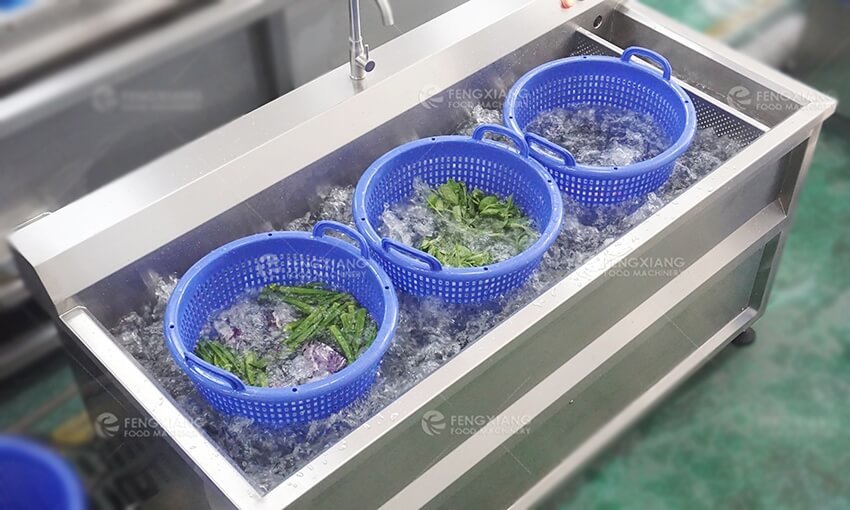
Fengxiang offers vegetable washing equipment in different configurations. Depending on the selected model, a solution may combine bubble washing, ozone treatment and optional ultrasonic cleaning. Match the machine and modules to your produce, target output and line layout; confirm model-specific dimensions and technical parameters during quotation.
Type, whole or cut condition, soil load and daily variation.
Required throughput, operating hours and acceptable process buffer.
Upstream preparation, downstream equipment, utilities and available floor space.
Confirm modules, cleaning procedure, safety controls and sample test plan.
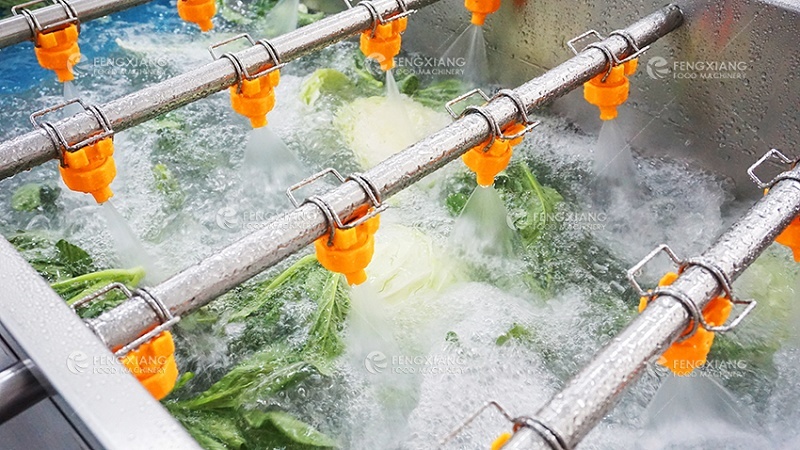
Fengxiang provides multiple vegetable washing machine configurations for different production capacities and process requirements. For higher throughput, a larger or more efficient model may be more suitable than a compact washer. Compare usable capacity, feeding and discharge, water management, footprint and line integration against your target output.
Ultrasonic and ozone modules are specified according to model availability and application needs. Ask Fengxiang to recommend and confirm the model, configuration and technical parameters for your line.
Capacity and performance vary by model and operating conditions. Confirm the required output and process details when requesting a quotation.
After washing, compatible stages may include cutting, dewatering and drying. Final equipment selection should follow the product specification and required process flow.
It is an industrial produce washing system that can combine bubble washing, ozone treatment and an optional ultrasonic module. The selected configuration should match the crop and process requirements.
Potential applications include leafy and root vegetables, fresh-cut vegetables, fruits and frozen-food ingredients. Suitability depends on product condition, washing method and handling setup.
High-frequency sound creates microscopic bubbles in the wash water. Their collapse (cavitation) produces local agitation that can help loosen particles from produce surfaces, including folds and crevices. Performance depends on equipment settings, water and produce conditions.
Ozone is an oxidizing treatment introduced into the wash water. It can react with some organic compounds and microorganisms, but the outcome depends on concentration, contact time, water quality and organic load. Validate the process and manage ozone safety controls.
Capacity depends on model, product type, feed method, wash process and operating conditions. Share a target output and product details to review a suitable configuration.
It can be planned with compatible cutting, dewatering, drying and packaging stages. Layout, transfer method and controls should be reviewed for the project.
No single equipment feature guarantees a specific microbial reduction or compliance outcome. Validate the full process with appropriate testing and maintain the facility's food-safety procedures.
Send your produce type, target output, factory layout and downstream process for a configuration review.
Recommend News



Contact Us
Whatsapp:+86-18024957831
Add: LiJian Office Building, Mugang Town, Duanzhou 8th Road, Zhaoqing City, Guangdong Province, China