

NEWS AND STORIES
Share the latest company updates, product launches, and inspiring stories from behind the scenes.

NEWS AND STORIES
Share the latest company updates, product launches, and inspiring stories from behind the scenes.
The Challenge of Mango Processing: Why Peeling Still Matters
Release time:
2025-07-16
Peeling mangoes is more complex than it seems. Discover why mango peeling machine step plays a key role in modern mango processing and how the industry is evolving.
From tropical orchards to processing lines, why peeling mangoes is still one of the trickiest steps

As summer arrives, so does the unmistakable aroma of ripe mangoes. Known as the “king of tropical fruits,” mangoes are rich in flavor, nutrients, and popularity. In recent years, they’ve also taken on a new role—not just in fresh markets, but in fruit juices, dried snacks, frozen cubes, purees, and even pre-made smoothies.
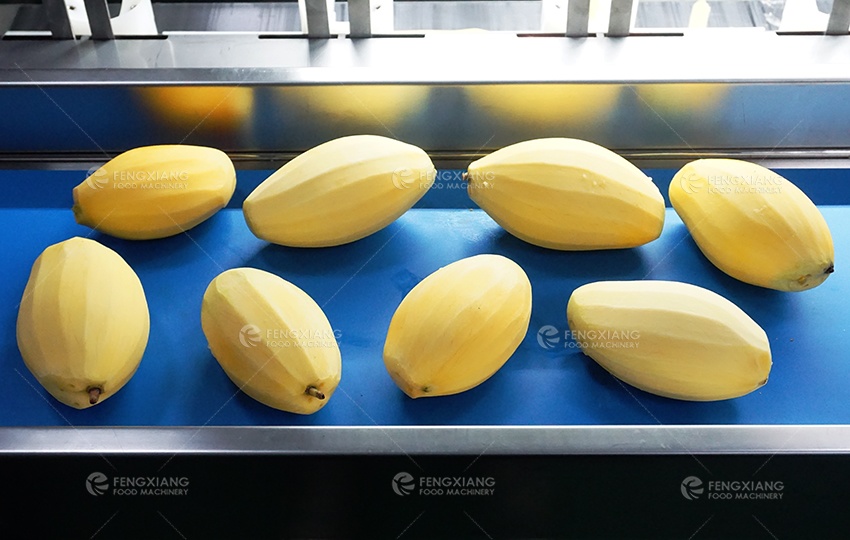 | Yet behind every neatly packed mango product is a surprisingly complicated journey. And one of the most underestimated steps in that journey? Peeling. |
Peeling a mango isn’t as simple as it sounds
Unlike apples or pears, mangoes don’t give up their skins easily. The peel is thin but tough, and the fruit underneath is soft, juicy, and slippery. On top of that, mangoes come in all shapes and sizes, depending on the variety, which makes standardizing the peeling process even harder.
In small-scale production or fruit production plants, worker often peel mangoes by hand. But when you’re processing hundreds or thousands of mangoes an hour, manual peeling isn’t just slow—it can lead to inconsistent quality, wasted fruit, and even safety concerns.
In the world of mango processing, automation is becoming essential
As the mango industry scales up to meet growing demand, the need for more efficient, hygienic, and standardized processing has become clear. Peeling, while often overlooked, is a crucial step in ensuring quality from the start.
More and more processing plants are turning to automated solutions to help improve productivity. Machines can peel faster, more evenly, and with less waste than manual labor. They also reduce the risk of contamination, which is vital in any modern food facility.
Of course, peeling mangoes by machine isn’t without its challenges. Mangoes aren’t uniform. Their size, shape, and pit location vary from one variety to another. A good peeling system needs to adapt to these differences without damaging the fruit or sacrificing too much edible flesh.
Why peeling still requires technical finesse
| Common mango peeling machine today combine mechanical design with intelligent control—using positioning systems, rotating blades, and flexible clamping mechanisms to achieve clean, consistent results. But even with these advancements, mango peeling remains a specialized task. |  |
In fact, for many processing lines, the peeling step sets the tone for the entire workflow. If the fruit isn’t peeled well, the cutting, slicing, de-seeding, and packing stages that follow become more complicated. Getting this first step right is essential—not just for appearance, but for overall yield and efficiency.
Looking ahead: better processing begins with a better peel
Peeling may seem like a small part of that puzzle, but in reality, it plays a big role. It’s where a raw fruit begins its transformation into a finished product—and where technology can make all the difference.
As the industry continues to evolve, mango peeling, like many other food processes, is steadily becoming more intelligent, more efficient, and more refined. And while the mango itself hasn’t changed, the way we handle it certainly has.
Recommend News



Contact Us
Whatsapp:+86-18024957831
Add: LiJian Office Building, Mugang Town, Duanzhou 8th Road, Zhaoqing City, Guangdong Province, China